
INVESTOR'S GUIDE
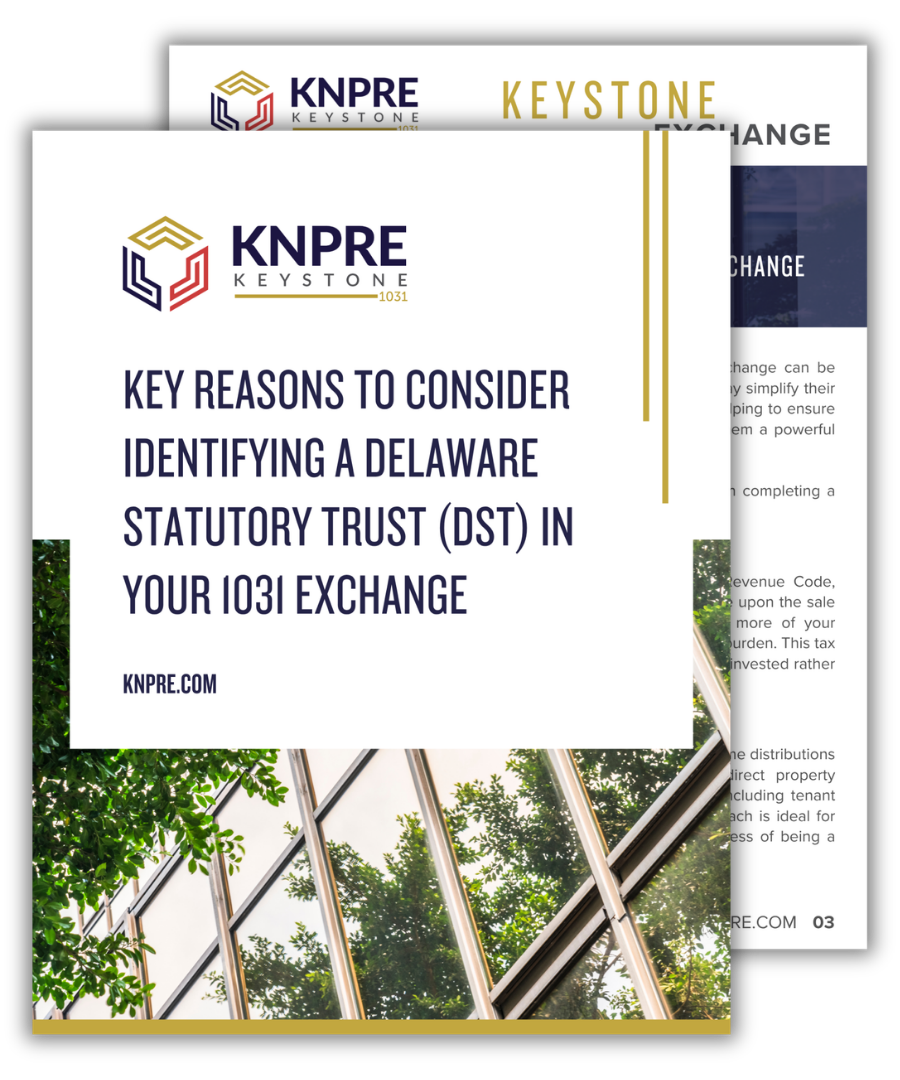
Key Reasons to Consider identifying a DST in your 1031 Exchange
A short guide to Delaware Statutory Trusts and why more 1031 exchange investors are identifying one alongside, or instead of, a traditional replacement property.
INVESTOR'S GUIDEBOOK
A safety net for your next exchange
Navigating the real estate market during a 1031 exchange can be daunting, but Delaware Statutory Trusts (DSTs) may simplify the experience. Because they're pre-packaged and qualify as like-kind property, DSTs can act as a reliable backup when a primary replacement property falls through, helping ensure your exchange closes and your tax deferral stays intact. This guide walks through six reasons investors are identifying a DST alongside their exchange.
- How a DST lets you defer capital gains taxes on the sale of investment property
- Why DSTs can generate passive, professionally managed income
- How fractional ownership opens the door to institutional-grade diversification
- Why DSTs act as a safety net if your exchange timeline is at risk
- How to put "leftover" exchange proceeds to work instead of taking taxable boot
- Why a DST doesn't have to be a permanent exit from active property ownership
EXCESS PROCEEDS, IN NUMBERS
What "leftover" proceeds are worth if you don't let them go
A simplified, hypothetical scenario: an investor sells a relinquished property for $1.5M, closes on a $1.3M replacement, and has to decide what to do with the remaining $200K.
TAKE THE BOOT
~$50,000
estimated tax due on $200K of taxable boot, at a ~25% combined rate
INVEST IT IN A DST
$0
tax due; the full $200K continues working toward your investment goals
$200K kept invested, not paid to the IRS from the same exchange, without changing the primary property
Hypothetical example for illustrative purposes only; it does not represent an actual or specific investment. Actual figures depend on individual tax circumstances and are never guaranteed. Consult your tax advisor. Full detail is in Reason Five of the guide.
INSIDE THE GUIDE
Six reasons, one download
Written for investors who are already exchanging and want to know where a DST might fit: as a primary strategy, a backup, or a place to park leftover proceeds.
Potential to Defer Capital Gains Taxes
Why DSTs qualify as like-kind property under Section 1031, and how deferring the tax bill keeps more capital working for you.
Generate Passive Income
Regular distributions and professional asset management, without the day-to-day responsibilities of being a landlord.
Diversify Your Real Estate Holdings
Fractional ownership of institutional-grade properties across asset types, tenants, and geographies, at a fraction of the capital it would take to buy outright.
Assurance Your Exchange Will Close
How a pre-packaged, readily available DST can act as a reliable backup when a primary replacement property falls through late in the exchange timeline.
Opportunity to Invest "Leftover" Exchange Proceeds
Putting excess proceeds to work in a DST instead of taking taxable boot, with lower minimums than buying a whole property.
Ability to Exchange Back into Active Ownership
Why a typical DST hold period still leaves the door open to return to direct, hands-on property ownership down the road.
FREE DOWNLOAD
Get the guide before you finalize your identification
Whether you're weighing a DST as a backup or as your primary strategy, this is the reference to read before your 45-day identification window closes.
+1 (212) 575-2152 · invest@knpre.com · New York | Los Angeles

Keystone 1031 is a member of the Keystone National Properties LLC Family of Companies
© 2026 Keystone National Properties LLC
For Educational Use Only
Not an offer to buy, nor a solicitation to sell securities. Information herein is provided for information purposes only, and should not be relied upon to make an investment decision. All investing involves risk of loss of some or all principal invested. Past performance is not indicative of future results. Speak to your finance and/or tax professional prior to investing.
For more information on Emerson Equity, please visit FINRA’s BrokerCheck website. You can also download a copy of Emerson Equity’s Customer Relationship Summary to learn more about their role and services.
Important Disclosure
The contents of this communication: (i) do not constitute an offer of securities or a solicitation of an offer to buy securities, (ii) offers can be made only by the confidential Private Placement Memorandum (the “PPM”) which is available upon request, (iii) do not and cannot replace the PPM and is qualified in its entirety by the PPM, and (iv) may not be relied upon in making an investment decision related to any investment offering by the issuer, or any affiliate, or partner thereof ("Issuer"). All potential investors must read the PPM and no person may invest without acknowledging receipt and complete review of the PPM. With respect to any “targeted” goals and performance levels outlined herein, these do not constitute a promise of performance, nor is there any assurance that the investment objectives of any program will be attained. All investments carry the risk of loss of some or all of the principal invested. These “targeted” factors are based upon reasonable assumptions more fully outlined in the Offering Documents/ PPM for the respective offering. Consult the PPM for investment conditions, risk factors, minimum requirements, fees and expenses and other pertinent information with respect to any investment. These investment opportunities have not been registered under the Securities Act of 1933 and are being offered pursuant to an exemption therefrom and from applicable state securities laws. All offerings are intended only for accredited investors unless otherwise specified. Past performance is no guarantee of future results. All information is subject to change. You should always consult a tax professional prior to investing. Investment offerings and investment decisions may only be made on the basis of a confidential private placement memorandum issued by Issuer, or one of its partner/issuers. Issuer does not warrant the accuracy or completeness of the information contained herein. Thank you for your cooperation.
Securities through Emerson Equity LLC Member: FINRA/SIPC. Only available in states where Emerson Equity LLC is registered. Emerson Equity LLC is not affiliated with any other entities identified in this communication.
1031 Risk Disclosure:
• There is no guarantee that any strategy will be successful or achieve investment objectives;
• Potential for property value loss – All real estate investments have the potential to lose value during the life of the investments;
• Change of tax status – The income stream and depreciation schedule for any investment property may affect the property owner’s income bracket and/or tax status. An unfavorable tax ruling may cancel deferral of capital gains and result in immediate tax liabilities;
• Potential for foreclosure – All financed real estate investments have potential for foreclosure;
• Illiquidity – Because 1031 exchanges are commonly offered through private placement offerings and are illiquid securities. There is no secondary market for these investments.
• Reduction or Elimination of Monthly Cash Flow Distributions – Like any investment in real estate, if a property unexpectedly loses tenants or sustains substantial damage, there is potential for suspension of cash flow distributions;
• Impact of fees/expenses – Costs associated with the transaction may impact investors’ returns and may outweigh the tax benefits.
By continuing to use this website, you agree to our Privacy Policy and consent to the use of cookies, tracking pixels, and similar technologies that may collect information such as your IP address, browsing activity, and usage data in accordance with California Penal Code § 638.51 and the California Invasion of Privacy Act (CIPA).